
A client says their body feels “out of balance.” For a cupping practitioner, that statement is an invitation to ask what they are experiencing. Does turning their head feel restricted? Are they looking for a comfortable way to unwind? Have they developed symptoms that need assessment by another professional?
The answer shapes the session more effectively than assuming that every complaint reflects the same underlying blockage. It also gives students a useful foundation for learning: connect the technique to a clear purpose, explain it accurately, and evaluate the response.
Balance and flow have a place in cupping’s traditional background. In professional education, these ideas are most helpful when students can distinguish traditional interpretation, measurable tissue responses, proposed mechanisms, and client-reported outcomes.
Begin With the Framework Behind the Words
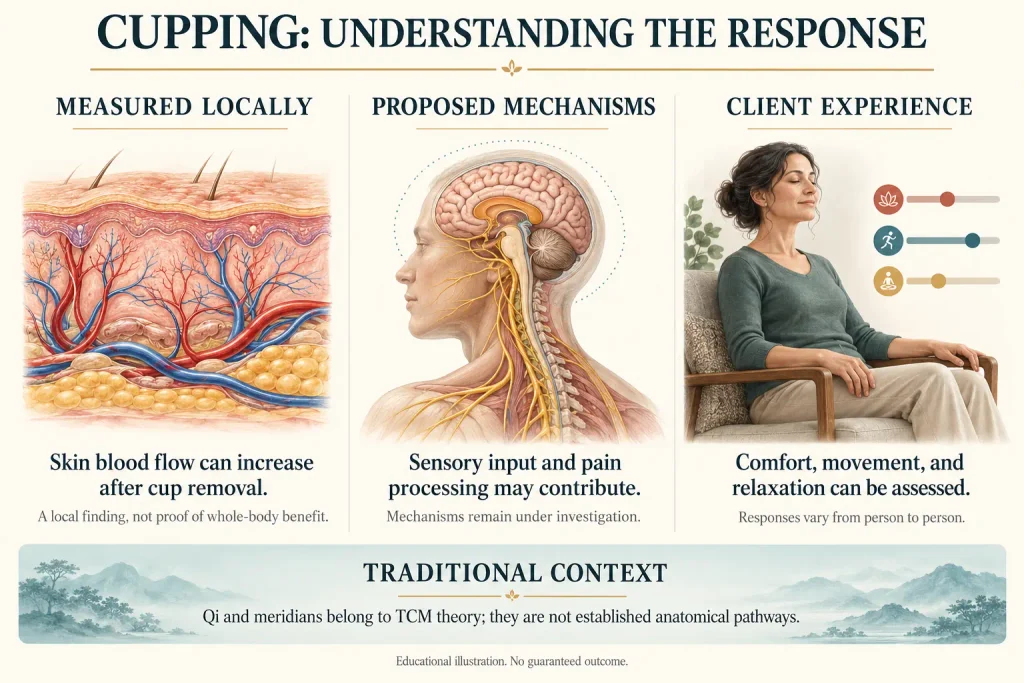
Traditional Chinese Medicine, or TCM, describes Qi and blood moving through a network of meridians. In that framework, stagnation can be part of the explanation for discomfort and disharmony, and cupping is traditionally used to encourage movement.
Students should understand those concepts in their cultural and theoretical context. Meridians are not established anatomical conduits equivalent to arteries, veins, or peripheral nerves. Likewise, a complaint such as fatigue or shoulder pain cannot be assigned to obstructed Qi as though that were a confirmed biomedical finding.
A practitioner trained in massage can acknowledge the traditional explanation while using language appropriate to their own education and scope. For instance: “TCM describes this in terms of Qi and blood. For today’s bodywork session, we can also identify a movement you want to feel more comfortable and reassess it afterward.”
The purpose of that explanation is informed understanding. It should not require clients to accept a belief system or suggest that a historical explanation establishes modern clinical effectiveness.
Separate Four Types of Information
A useful learning exercise is to sort statements about cupping before using them in a consultation or treatment note. Ask what kind of claim each statement makes and what would be needed to support it.
Traditional interpretation
“Encouraging the movement of Qi” describes an idea within TCM. It should be identified as such rather than presented as an observed anatomical event.
Measurable local response
Cupping therapy applies negative pressure that draws skin and superficial tissue into a cup. Small experiments have also measured increased local skin blood flow after cup removal. A local response does not demonstrate a systemic treatment effect.
Proposed mechanism
Sensory stimulation and changes in pain processing have been suggested as possible contributors to cupping’s effects. They remain hypotheses under investigation. Knowing a proposed mechanism is useful for study; it does not justify promising that a particular client’s pain will resolve.
Reported outcome
“The client reported less pulling while reaching” records an experience. It does not establish that an adhesion was broken, fascia was permanently changed, or an energy blockage was removed. A well-written record can describe the improvement without making those additional claims.
Assess Before Choosing the Application
Learning to place a cup is only one part of learning to use cupping responsibly. The first decision is whether the modality suits the person, the area, and the intended goal. Review relevant health history, explain the proposed approach, and obtain consent before applying suction.
Within the practitioner’s scope, establish a simple baseline. This might be the client’s description of discomfort during a familiar activity or their comfort with an ordinary movement. Use the same activity when reassessing so the comparison remains meaningful.
Avoid turning the baseline into a test the client feels expected to pass. Ask neutral questions, such as “What do you notice now?” rather than “Does that feel much better?” The answer may be improvement, no change, or irritation. All three provide useful information.
Practice Adapting Instead of Chasing Intensity
Application choices include location, suction, duration, and whether a cup remains in place or moves over suitably lubricated skin. These variables should be taught in the context of the equipment, the treatment goal, and the client’s tolerance. A general blog article cannot supply a universal dose for every person and technique.
More suction and more pronounced discoloration do not establish a better treatment. Students benefit from learning how to recognize an acceptable pulling sensation, check skin response, and respond promptly when the client reports discomfort.
Communication can be specific: explain what sensation the client might notice, ask them to report changes, and make clear that treatment can stop. Sharp pain, burning, or distress should lead to stopping and reassessing, rather than encouraging the client to tolerate it for an assumed benefit.
Teach Relaxation Without Promising a Reset
The autonomic nervous system is sometimes described as a contest between “fight or flight” and “rest and digest.” That shorthand leaves out the ongoing, coordinated roles of its sympathetic and parasympathetic branches.
Clients may feel calmer during a comfortable cupping session, but a calm appearance or a report of relaxation does not prove a nervous system reset. A practitioner should distinguish what the client says from what would require physiological measurement, and distinguish a short-term state from treatment of a medical condition.
For students, this leads to useful practical questions. Was the positioning comfortable? Did the client understand what would happen next? Were they able to ask for a change? These observations support a thoughtful treatment experience without requiring speculative claims about autonomic regulation.
Interpret Evidence at the Right Level
Research on cupping includes encouraging pain findings alongside methodological limitations. Variation in techniques, comparison treatments, and study quality affects how confidently the results can guide practice.
A 2011 randomized pilot study of cupping therapy for chronic nonspecific neck pain enrolled 50 patients and found lower pain than a waiting-list control. Without a sham comparison, it could not isolate suction-specific effects from other influences on the treatment experience.
Students should ask whether a study examined a comparable technique, treatment schedule, and population. A result from one cupping protocol does not establish the effects of every cupping application. Similarly, a skin blood-flow experiment cannot answer whether a course of treatment improves a chronic pain condition.
This distinction does not make clinical observations unimportant. It makes documentation more useful. Record the technique, the person’s response, and what remains uncertain, so later decisions draw on something more specific than a general impression of balance.
Make Screening and Equipment Care Core Skills
Practical training should address contraindications, skin inspection, consent, and equipment care alongside technique. Do not apply cups over wounds, infected skin, or an area with a suspected clot. A suspected clot needs medical assessment. Anticoagulant use and bleeding disorders require medical guidance before considering cupping.
Explain possible marks and adverse skin reactions before treatment. Use cleaning and reprocessing procedures appropriate to the equipment and applicable infection-control requirements; intact-looking skin does not eliminate the need for proper precautions.
These examples do not replace a full screening process. Students also need to recognize when unexplained or worsening symptoms call for referral and when a client’s needs exceed their training or professional scope.
Choose Education That Supports Professional Judgment
When comparing educational options, look for more than a demonstration of cup placement. Review how a course addresses assessment, adapting techniques, contraindications, equipment care, and communication. Consider what opportunities you will have to practice and identify where you need further feedback.
ACE’s ACE Massage Cupping Therapy: Home Study – Full Course introduces manual cupping fundamentals and techniques. Its published curriculum includes safety and contraindications, care of equipment, and integration into practice. Review the current course details when deciding whether it fits your learning goals.
Course completion or a training certificate does not by itself expand a professional license. Confirm the rules and scope that apply to your work before offering cupping services.
Get Certified in Cupping Therapy
Take your practice to the next level with a Cupping Therapy Certification. Whether you’re a massage therapist, acupuncturist, or wellness professional, our certification courses provide you with the knowledge and skills to offer safe, effective cupping therapy treatments.
Benefits of Certification:
- Gain credibility and attract more clients
- Learn advanced techniques from industry leaders
- Earn NCBTMB-approved CEUs
Start your certification journey today!
Recommended Online Courses


Turn the Language of Balance Into Better Decisions
A capable practitioner can acknowledge traditional ideas, discuss emerging research, and listen closely to a client without confusing those sources of knowledge. Each contributes something different to the conversation.
The practical value of “balance and flow” emerges when the session has a clear aim, the client understands the approach, and the outcome is described honestly. Education should help practitioners make those decisions with care, recognize the limits of their knowledge, and keep improving the quality of the experience they provide.